evidence-based design
practical foundations course
The most comprehensive introductory course for evidence-based design, built for students, researchers, and experienced design professionals. No pre-requisites. Taught by Dr. Kati Peditto, Cornell-trained design psychologist and the researcher behind Built Experience Lab.

↓
LEARN the KEY RESEARCH
↓
PRACTICE the EBD PROCESS
↓
GET HIRED and ADD VALUE


it’s time we stopped guessing about design strategy.
→ Design professionals: Your clients are getting smarter. They want to know the why behind your design decisions. Without rigorous data, design strategies feel anecdotal, making it harder to win high-stakes, research-driven RFPs, justify innovative solutions, or earn repeat work by showing return-on-investment.
→ Students: It’s tough out there on the job market. If you want to differentiate yourself, your portfolio needs to be more than just aesthetic. Internships and positions like workplace strategist and design futurist are reserved for students who can actually demonstrate their ability to make smart, defensible design decisions.
→ Researchers: Your research degree is extremely valuable. Trust me, I was a PhD student on the job market once too. Design firms are looking to hire research talent, but they need to trust that you can speak the language of design - not just research jargon. Let me show you what I’ve learned about design research and communication.

INTRODUCING
Evidence-Based Design: Practical Foundations
Over 14 weeks, you will explore the foundations of evidence-based design. You'll practice the research methods used most frequently in design practice, you'll learn key theories and findings, and you'll be prepared to integrate research in the design process.


THE COURSE INCLUDES
Six 2-Hour Video Modules
that teach you the foundation of EBD through video lessons + worksheets.
Coaching From Dr. Peditto
to help you develop a portfolio-ready set of evidence-based design guidelines.
Private Community Group
to share experiences (and challenges!) integrating EBD into practice.
Downloadable Workbook
for note-keeping, key references, and documenting progress on the course project.
Weekly Open Office Hours
for any questions about the course material and final project.
One Intensive Project
that will demonstrate your expertise in evidence-based design to employers and clients.
it’s time we starting using science for design.



MEET YOUR INSTRUCTOR
HI, I’M KATI!
_
There’s not much you can do with a B.A. in Psychology, or so I quickly learned when I decided I didn’t want to become a counselor or clinician. I took the path less traveled and far less lucrative, pursuing research in Human Behavior and Design at Cornell University. My doctoral advisor was an architect, and we certainly made a funny pairing: I was a social scientist and I had to quickly learn the language of design.
I think she’s still convinced I’ll go to architecture school someday. I was convinced I’d be a professor for the rest of my life. After one year on the tenure track, I realized I loved teaching but dearly missed design practice. Since then, I’ve worked as a researcher for three of the largest A/E/C firms on the planet.
In that time, I’ve seen a LOT of bad design decisions. Not ugly, not offensive. But uninformed and ultimately, not a good investment for the client. It’s time we stopped guessing about good design. This course is your first step in closing the gap between design strategy and science through the practice of evidence-based design.
BY THE END THE COURSE YOU WILL:
NO. 1
Know the landscape.
Recall the landmark studies, foundational theorists, and professional organizations, like EDRA, the Center for Health Design, and WELL, that define evidence-based design today.
NO. 2
Explain the mechanisms.
Explain the psychological and physiological mechanisms, from attention restoration to stress recovery, through which specific built-environment conditions affect occupant health, cognition, and wellbeing.
NO. 3
Build your own hypotheses.
Apply EBD research to generate a specific, testable IF/THEN hypothesis and a matching set of evidence-based design criteria for a self-selected space type.
NO. 4
Evaluate the evidence.
Distinguish strong evidence from weak evidence in the EBD literature, using the evidence hierarchy to judge a study's methodology, sample size, and replication status before using it to inform design.
NO. 5
Propose new research.
Design a basic post-occupancy evaluation, deciding what questions to ask and what measurement tools fit the context, and propose foundational primary methods like interviews, surveys, and focus groups.
NO. 6
Create your own EBD guidelines.
Produce a portfolio-ready EBD project that demonstrates your ability to move from theory to design strategy to anticipated outcome, and articulate the business case behind it clearly enough for a client or employer.
WHAT’S INSIDE
The Evidence-Based Design: Practical Foundations course is a 14-week hybrid learning and coaching program designed to teach you to find, read, construct, and apply peer-reviewed science to design decisions.

-
What is Evidence-Based Design?
The Intellectual Origins of EBD
The Professional Landscape
Landmark Studies
The IF/THEN Framework
The Business Case for EBD
Module No. 01

-
Research 101
Evaluating a Study
Writing IF/THEN Hypotheses
Primary Research Methods
Post-Occupancy Evaluation
Module No. 02

-
Light and Vision
Color
Acoustics and Hearing
Thermal Comfort
Air Quality
Module No. 03
-
Attention Restoration Theory
Stress Reduction Theory
Biophilia Hypothesis
Environmental Press
Affordance Theory
Prospect-Refuge Theory
Reciprocality
Module No. 04

-
Privacy and Regulation
Crowding and Density
Proxemics
Wayfinding and Spatial Cognition
Place Attachment and Place Identity
Identity and Inclusion
Module No. 05

-
Integrating EBD into the Design Process
Criteria vs. Prescription
Communicating to Multiple Audiences
POE for Business
Module No. 06
PLUS A 50+ page guide
↓
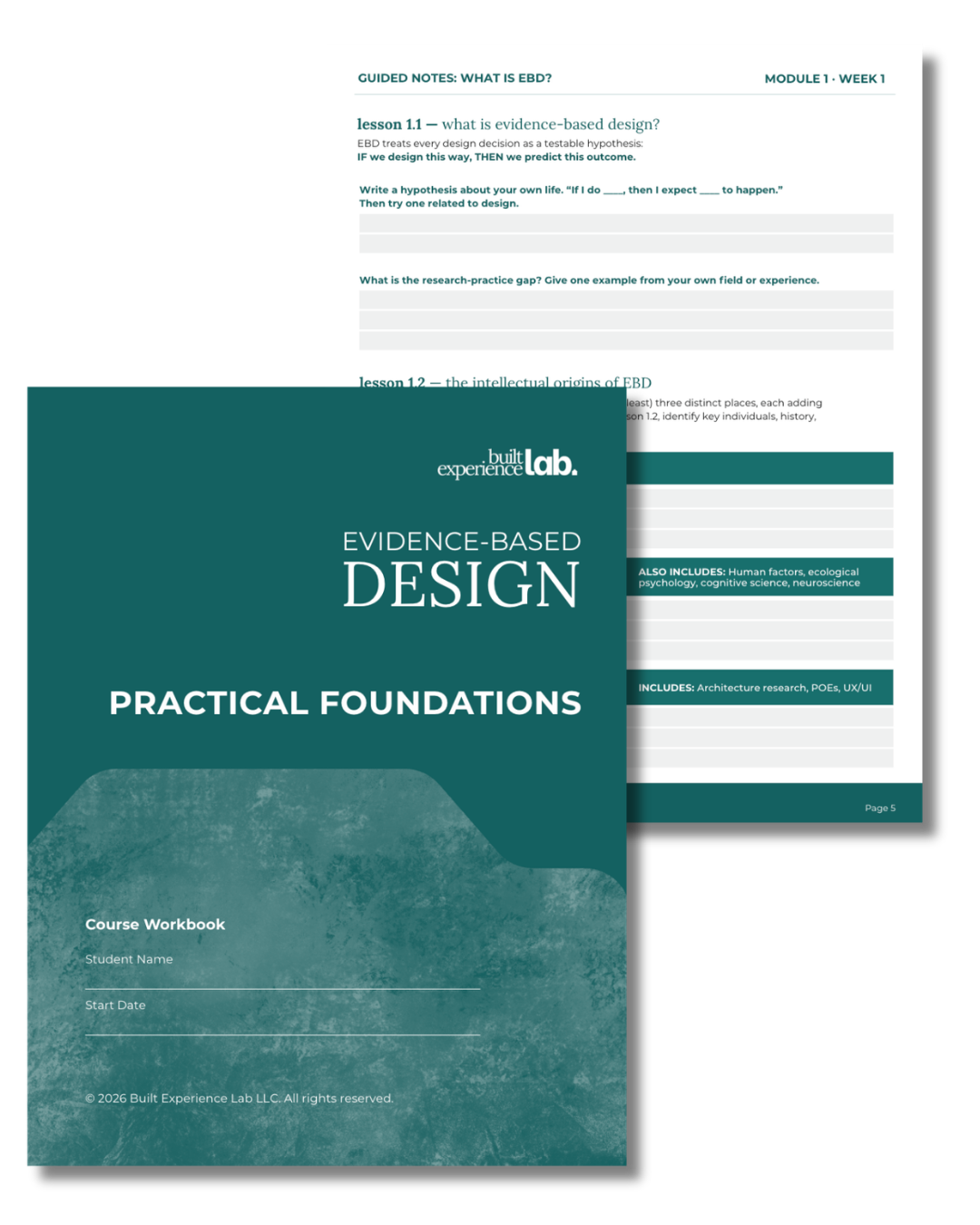

evidence-based design reference and lesson workbook
Every lesson comes with guided prompts to apply what you just watched, as well as key reference pages for future use. The workbook was built alongside the course content itself, matching the content of each lesson and designed to be an evergreen document long after the course ends. These workbook pages will support your finished, portfolio-ready deliverable, ready to share with an employer or client.
free preview available
before registering, check out the first lesson (yes, in full!) and an introduction to the companion workbook. get a feel for the quality of the course content and platform, and see how we develop that final project.


have any questions?
-
Not quite. It’s a hybrid course, so you get both accountability and flexibility.
There are six modules over a 14-week course. The modules are released every 2-3 weeks, and students complete each module asynchronously. There will be weekly office hours + two opportunities for students to receive assignment feedback and coaching in a live 1:1 session with Dr. Peditto.
-
Check out the upcoming cohort dates here. The course runs several times per year.
-
Yes! More CEU information incoming soon.
-
Yes! Many firms offer an annual allowance for professional development. Inquire with your supervisor or benefits director.
This course qualifies for CEUs and the course project is designed to directly integrate with a current professional project (if desired).
Employers: If you would like to offer the course at your firm, please inquire for a group rate.
-
No - and that’s on purpose.
A credential proves you passed a test, and that's not the intention of this course. Instead, we’ll focus on the evidence behind evidence-based design. You’ll learn key theories and studies to inform your final deliverable - a portfolio-ready project that can be immediately used in interviews and with clients.
And if you choose to pursue credentialing, this course provides a valuable foundation.
-
Trust me - this is the “proof” of EBD.
I’ve spoken to hundreds of professionals about the challenges of evidence-based design. The big issue is often not learning and testing the material - it’s actually putting it into practice on a project.
Instead of asking you to test your knowledge, this course will help you SHOW it. The next time you apply for a job or participate in a client interview, you’ll have a portfolio-ready piece to demonstrate your expertise.
-
This course is designed for anyone looking to make an impact in the built environment. No pre-requisites.
You’ll benefit from some familiarity with the A/E/C design process, but this course is intended for students, researchers, design professionals, and even firm leadership. If you have questions about your suitability for the course, please inquire.
-
Absolutely - and you’ll immediately see the benefit. This course qualifies for CEUs and the course project is designed to directly integrate with a current firm project (if desired).
Inquire about group rates and custom cohort timing.
upcoming cohorts
-
![]()
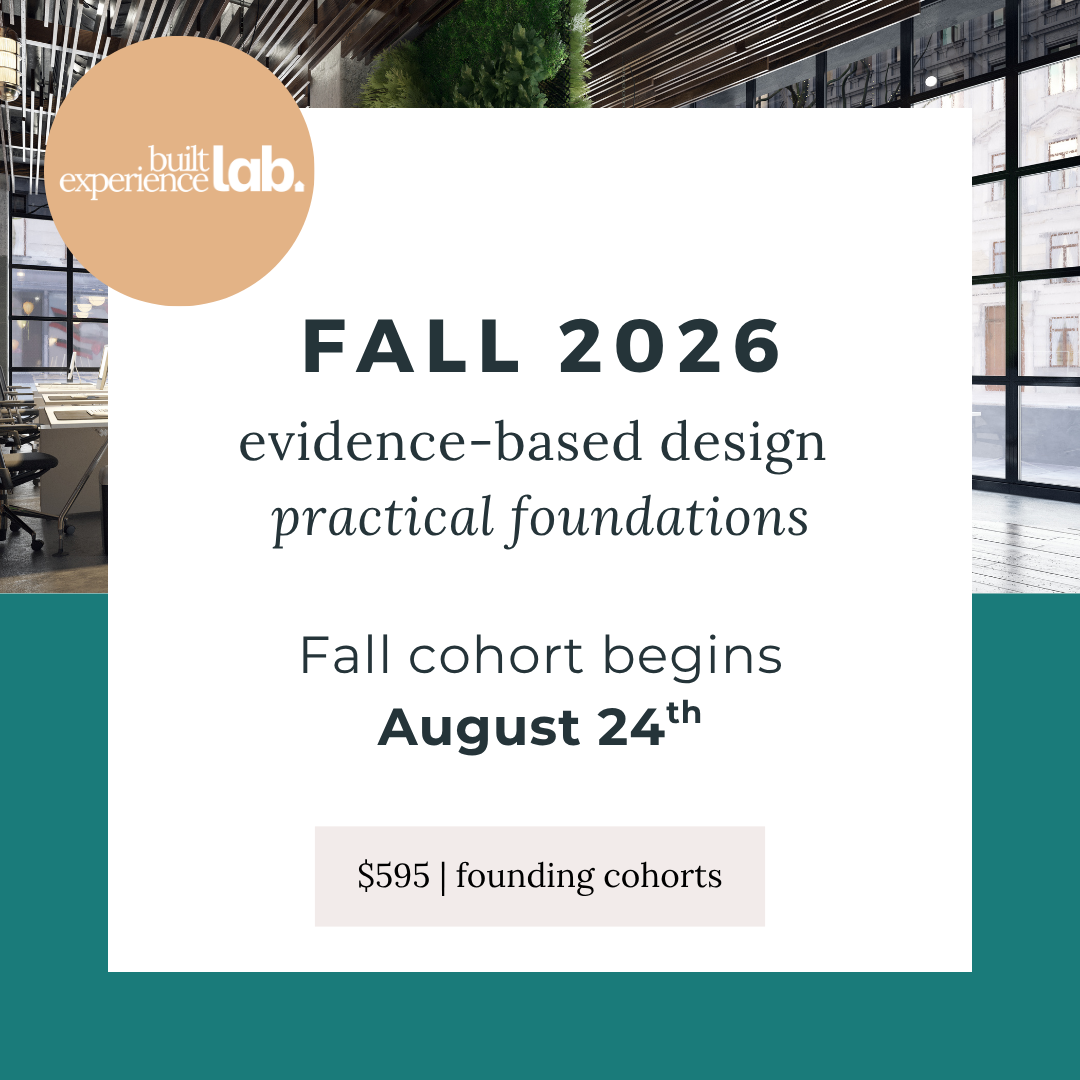
14 weeks beginning Monday, August 24th, 2026. Beta access at a reduced rate for a small feedback group. $595.
-
![]()
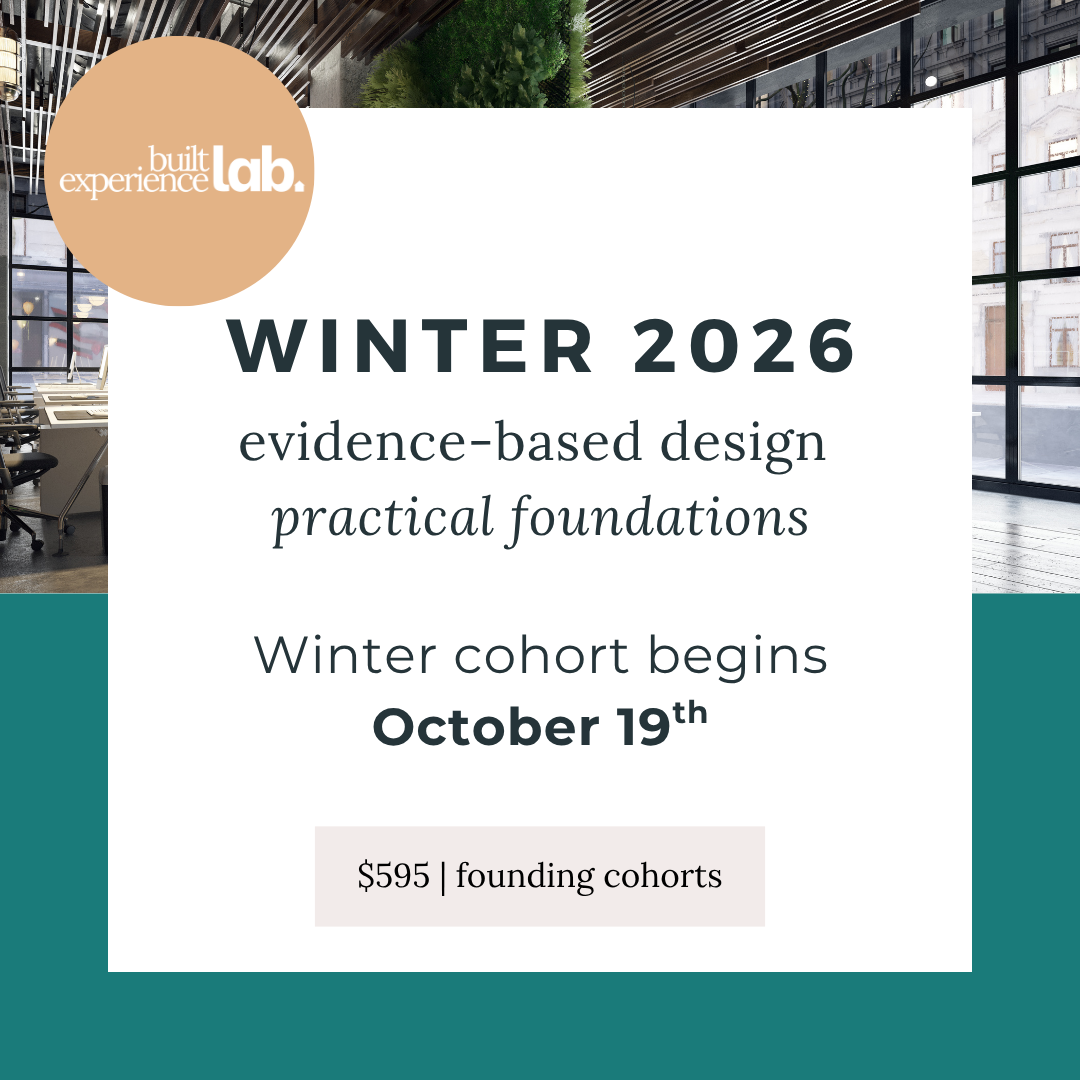
14 weeks beginning Monday, October 19th. Includes break for winter holiday. Beta access at a reduced rate for a small feedback group. $595.
-
![]()
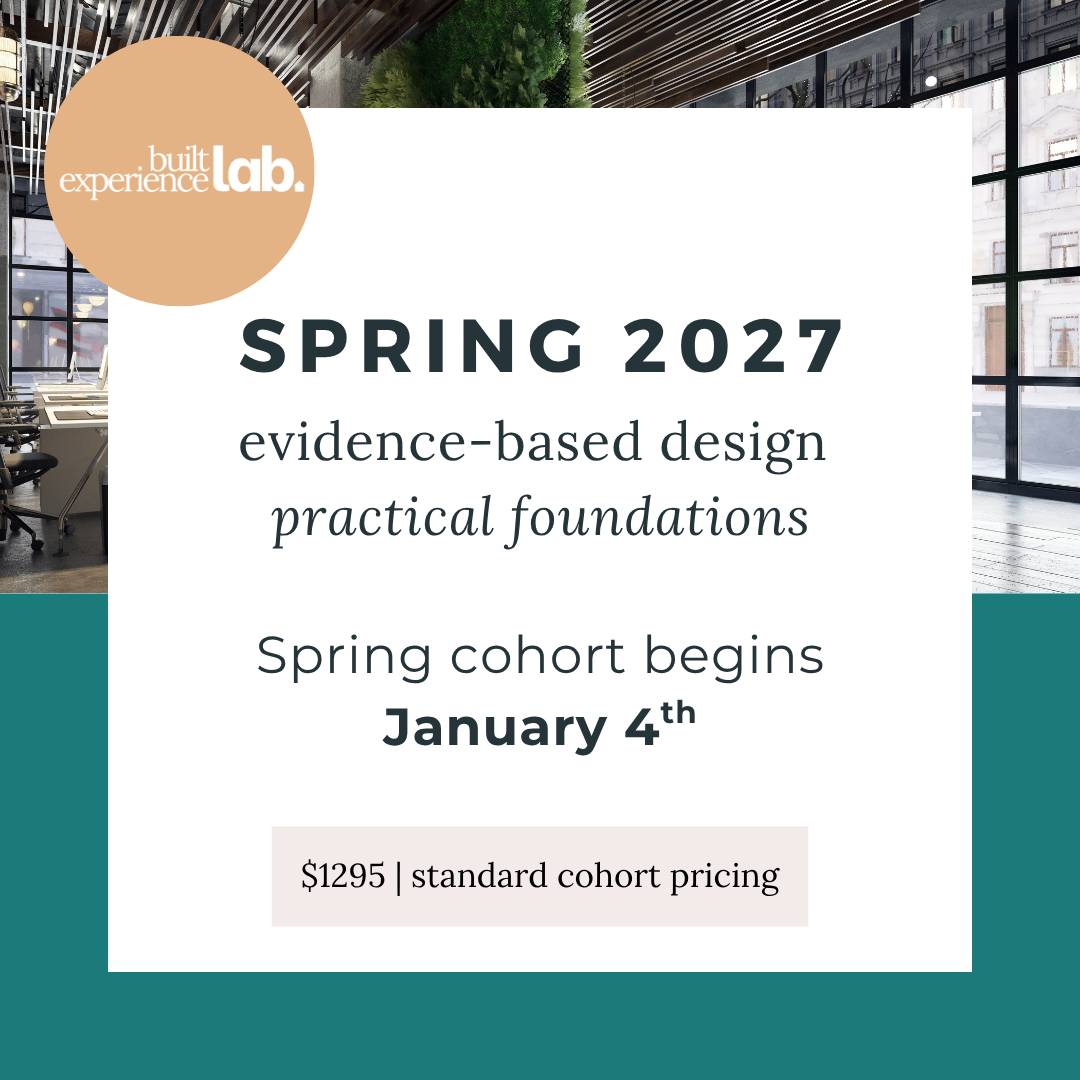
14 weeks beginning Monday, January 4th. Enrollment limited to 15 students. Standard student pricing begins in 2027. $1295.